
Industrial generators and electric motors play an essential role in modern industrial operations. These machines support power generation, manufacturing processes, utility systems, production facilities, and various applications that depend on a reliable electrical supply.
To maintain operational reliability, industrial electrical machines require systematic inspection and maintenance. One important aspect of this process is industrial generator rotor and stator maintenance, which focuses on evaluating the condition of two fundamental components of an electrical machine.
The rotor and stator perform different but closely related functions. The rotor is the rotating component, while the stator is the stationary component. In many generator designs, the interaction between magnetic fields and electrical windings enables the conversion of mechanical energy into electrical energy.
Because these components operate as part of an integrated system, their condition can influence machine performance, operational stability, efficiency, and reliability.
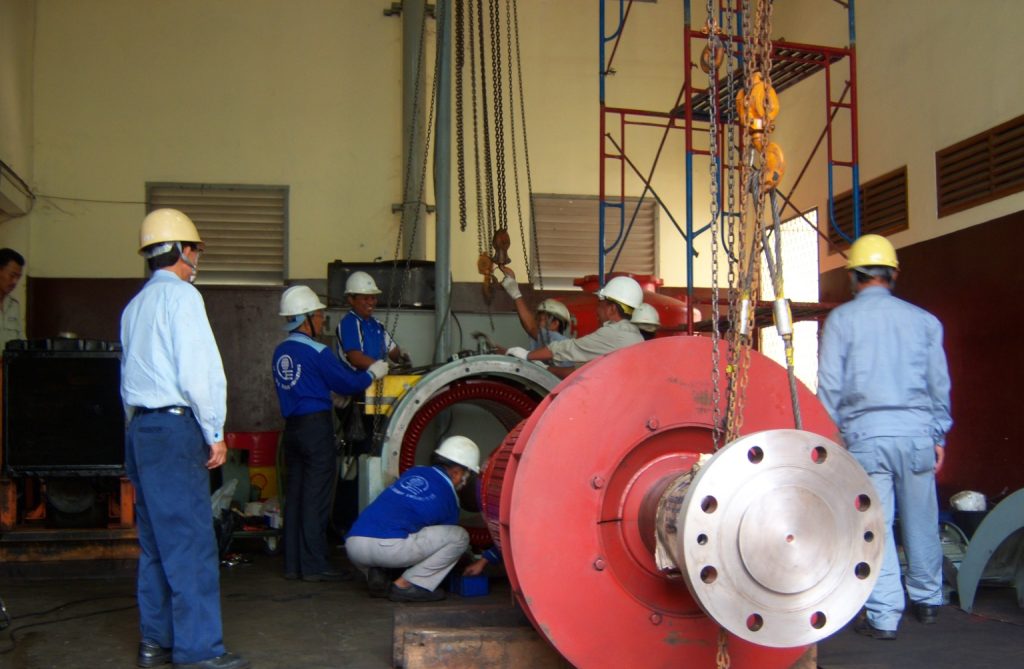
The photographs accompanying this article show technicians working with a large electrical machine component in an industrial workshop. Chains and lifting equipment are used to handle heavy components, while other technicians work around the exposed machine assembly.
This type of activity illustrates the technical complexity of industrial electrical maintenance. Successful maintenance requires more than electrical knowledge. It also involves mechanical understanding, lifting preparation, teamwork, equipment inspection, and strict adherence to workplace safety procedures.
For industrial operators, understanding these maintenance activities can help improve maintenance planning and support informed decisions about the condition of critical electrical equipment.
What Are the Rotor and Stator in an Industrial Generator?
Understanding the basic functions of the rotor and stator provides a foundation for understanding why both components require regular inspection.
1. The rotor: The rotating component
The rotor is the part of an electrical machine that rotates during operation. Depending on the machine design, it may contain a shaft, magnetic poles, windings, a rotor core, and other mechanical components.
In many synchronous generators, the rotor produces a magnetic field that interacts with the stator windings. As the rotor turns, the changing magnetic flux induces voltage in the stator windings through electromagnetic induction.
The rotor must operate under mechanical conditions that require appropriate balance, alignment, structural integrity, and clearance. Excessive vibration, bearing problems, shaft misalignment, or mechanical imbalance may affect the machine’s performance.
Rotor inspections should therefore be based on the generator design, operating history, measurement results, and the manufacturer’s technical recommendations.
Depending on the findings, maintenance may involve visual inspection, dimensional measurements, mechanical checks, or other specialized procedures.
2. The stator: The stationary component
The stator is the stationary part of an electrical machine. It commonly consists of a stator core and electrical windings installed in designated slots.
In many industrial generators, the stator windings are where electrical voltage is induced as the rotor’s magnetic field changes relative to them.
The condition of the stator is critical because winding insulation problems, contamination, moisture, loose connections, and cooling-system issues may reduce equipment reliability.
Stator inspection can include visual examination, appropriate cleaning, connection checks, and electrical testing. The specific procedures depend on the machine design, operating conditions, and applicable technical requirements.
Electrical tests should be conducted by qualified personnel using suitable instruments and established acceptance criteria.
3. Why should the rotor and stator be inspected together?
Although the rotor and stator have different functions, they operate as an integrated system.
For example, excessive rotor vibration may indicate a mechanical problem that could affect the clearance between the rotor and stator. Similarly, contamination or damage affecting the stator may require investigation to prevent further deterioration.
Inspecting both components within the context of the entire machine helps maintenance teams identify potential relationships between mechanical and electrical problems.
This approach also reduces the risk of treating a visible symptom without investigating its underlying cause.
When Does an Industrial Generator Need an Overhaul?
An overhaul is a more extensive maintenance activity whose scope depends on the equipment’s condition, operating history, manufacturer recommendations, and inspection findings.
Not every generator requires the same overhaul interval. Some machines may need routine inspection and condition monitoring, while others may require extensive work after a fault or when specific maintenance milestones are reached.
Several conditions may indicate the need for further investigation.
1. Abnormal vibration or noise
Increasing vibration or unusual noise may be associated with rotor imbalance, shaft misalignment, bearing deterioration, loose components, or other mechanical issues.
However, the cause should not be determined from sound or vibration alone.
Vibration measurements, operating data, and additional mechanical inspections can help establish whether corrective action is necessary.
2. Increasing operating temperature
Temperatures outside the expected operating range may indicate cooling-system problems, excessive loading, electrical connection issues, or other abnormal conditions.
Temperature readings should be evaluated against the manufacturer’s limits and the machine’s historical operating data.
3. Changes in electrical test results
Changes in insulation resistance, winding test results, or other electrical measurements may indicate a condition that requires further investigation.
Test results must be interpreted according to the equipment design, test temperature, environmental conditions, and applicable technical standards. A single measurement does not necessarily establish the overall condition of a generator.
4. Scheduled preventive maintenance
A machine can require inspection even when it appears to operate normally.
Some forms of deterioration develop gradually and may not produce obvious symptoms during routine operation.
A preventive maintenance program helps identify changes in equipment condition and provides a basis for deciding whether additional inspection or corrective work is required.
5. Equipment failure or an unexpected shutdown
A significant failure may require a more extensive inspection to determine its cause.
The decision to dismantle a generator should be based on technical evaluation and the actual condition of the equipment, rather than automatically assuming that a complete overhaul is necessary.
A structured diagnostic process helps define the work scope, spare-parts requirements, estimated downtime, and post-maintenance testing requirements.
Key Stages of Industrial Generator Rotor and Stator Maintenance
Maintaining a generator is not simply a matter of dismantling components, cleaning them, and putting them back together. The process requires a systematic workflow.
1. Initial inspection and data collection
The first stage involves reviewing the generator’s technical information and maintenance history.
Relevant information may include the machine type, model, operating conditions, previous faults, maintenance records, and historical measurement results.
Technicians should also understand the operator’s reported symptoms and the circumstances in which problems occurred.
Initial documentation may include photographs, component identification, position markings, and records of connections or parts that will be removed.
Good documentation helps establish a baseline for subsequent inspection and supports accurate reassembly.
2. Energy isolation and safety preparation
Before maintenance begins, relevant energy sources must be isolated according to the applicable safety procedures.
This may include lockout/tagout (LOTO), verification of the de-energized condition, securing mechanical energy, and controlling stored energy.
When work involves rotating machinery or heavy components, personal protective equipment alone is not sufficient. A safe work plan should also address hazard identification, role allocation, communication, supervision, and control of access to the work area.
The work must not proceed until the required safety conditions have been verified.
3. Systematic component dismantling
Dismantling should follow the machine’s construction and the manufacturer’s procedures.
Technicians must pay attention to fasteners, connections, bearings, covers, and other parts that may affect the removal process.
Removed components should be identified and stored safely to prevent damage or confusion during reassembly.
Photographs and written records can help preserve information about component orientation and installation positions.
4. Lifting and handling heavy components
Lifting is one of the most important stages when maintaining large industrial electrical machines.
The photographs used in this article show technicians working with chains and lifting equipment to handle a substantial machine component.
Before lifting begins, the team should establish the component’s weight, approved lifting points, lifting-equipment capacity, rigging configuration, and the stability of the work area.
The lifting plan must consider the center of gravity, possible load movement, travel path, and the position of personnel. Equipment must never be used beyond its applicable rated capacity, and workers must not stand beneath a suspended load.
Chains, slings, hoists, and other lifting accessories must be suitable for the intended application and inspected according to applicable procedures.
Only competent personnel should perform or supervise the lifting operation, with clear communication throughout the process.
5. Component inspection and cleaning
Once the relevant components are accessible, technicians conduct inspections according to the defined scope of work.
Rotor inspection may include examining the shaft, surfaces, mechanical components, and visible signs of damage.
Stator inspection may include evaluating the core, windings, insulation, electrical connections, and indications of contamination or overheating.
Cleaning methods must be compatible with the materials, insulation systems, and manufacturer’s instructions.
Using unsuitable chemicals, excessive force, or inappropriate cleaning techniques can cause additional damage.
6. Electrical and mechanical testing
Visual inspection may be supplemented by electrical and mechanical testing.
The appropriate tests depend on the machine design, inspection findings, and the approved maintenance procedure.
Results should be documented and compared with relevant acceptance criteria. If abnormalities are identified, the maintenance team should determine their significance and recommend appropriate corrective action.
Testing should be performed by qualified personnel using suitable instruments and established procedures.
7. Repair and reassembly
Corrective work should be based on the inspection findings.
Depending on the condition of the equipment, this may involve cleaning, replacing damaged components, repairing connections, or carrying out other technically justified work.
During reassembly, technicians must pay attention to component position, alignment, tightening requirements, clearances, and other parameters specified by the manufacturer.
The exact procedures vary between machine models and should not be generalized without reference to the applicable technical documentation.
8. Final inspection and commissioning tests
Before a machine returns to service, the maintenance team should conduct the required final inspections and tests.
These activities help verify that the maintenance work has been completed correctly and that the equipment meets the defined acceptance criteria.
Test results, completed work, inspection findings, and recommendations for future maintenance should be documented.
This information becomes part of the machine’s maintenance history and supports future reliability assessments.
Benefits of Planned Industrial Generator Maintenance
A structured maintenance program can provide several benefits to industrial facilities.
Improved equipment reliability. Periodic inspection can identify developing problems before they progress into more serious operational disruptions.
Better shutdown planning. Planned maintenance allows companies to coordinate production schedules, personnel availability, and material requirements.
More informed maintenance spending. Early identification of defects can help limit the consequences of further damage. Actual cost savings depend on the equipment’s condition, the underlying problem, and the effectiveness of the corrective action.
Stronger safety management. Systematic inspection can help identify electrical and mechanical hazards. Maintenance activities themselves must still be performed under appropriate safety controls.
Better technical documentation. Inspection records and test results allow maintenance teams to compare equipment condition over time and prioritize future work.
These benefits depend on appropriate maintenance planning, competent execution, and the use of reliable technical information.
The Importance of Qualified Technicians and Suitable Equipment
Industrial generator maintenance combines electrical, mechanical, and safety-related activities. Each requires appropriate knowledge, tools, and procedures.
For lifting operations, equipment capacity must be evaluated against the actual load and lifting configuration. Electrical work requires instruments appropriate to the tests being performed. Mechanical reassembly requires careful adherence to the machine’s technical specifications.
Industrial operators should establish the work scope, responsibilities, safety requirements, and acceptance criteria before maintenance begins.
They should also ensure that inspection findings and corrective recommendations are documented clearly.
For PT Global Teknik Engineering, publishing accurate technical information and verified project documentation can help customers better understand industrial maintenance activities and the considerations involved in handling large electrical machine components.
Any statements about specific services, certifications, project history, or technical capabilities should be based on information that the company can verify.
Generator Maintenance as a Long-Term Reliability Strategy
Industrial generators are valuable assets that may be essential to continuous operations. Their maintenance should therefore be treated as part of an overall asset-management strategy rather than only as a response to failure.
A more effective approach combines scheduled inspection, condition monitoring, measurement records, and risk-based maintenance planning.
This approach helps companies make informed decisions about inspection intervals, repair requirements, and the timing of more extensive maintenance activities.
Every generator has its own characteristics. Inspection intervals, testing methods, and overhaul requirements must reflect actual operating conditions, manufacturer recommendations, and applicable technical requirements.
Through appropriate planning, industrial generator rotor and stator maintenance can support equipment reliability, operational efficiency, and safe working practices.
Related Industrial Engineering and Maintenance Services
Rotor and stator maintenance is part of the broader field of industrial equipment maintenance.
Depending on the facility and the equipment involved, maintenance activities may also include electric motor inspection, mechanical component handling, and other industrial engineering work.
For a complementary discussion of heavy-component handling, maintenance planning, and safety during major electrical machine work, read the related article on industrial electrical machine overhaul and heavy-component handling.
This related article focuses on the overall overhaul workflow, while the present article emphasizes rotor and stator functions, inspection, and maintenance.
Together, these resources help industrial readers understand the technical and operational considerations involved in maintaining large electrical machines.
Industrial generator rotor and stator maintenance is an important part of maintaining electrical equipment and supporting reliable industrial operations.
The process may include initial inspection, energy isolation, dismantling, safe lifting, component inspection, electrical and mechanical testing, corrective work, reassembly, and final evaluation.
Each stage requires appropriate planning, competent personnel, suitable equipment, and clear documentation. Handling heavy components also demands careful consideration of load capacity, lifting points, center of gravity, and work-area controls.
For industrial companies, a structured maintenance program provides a stronger technical basis for protecting equipment, managing risks, and planning operational continuity.
PT Global Teknik Engineering can use accurate technical articles and verified work documentation to educate customers and strengthen its online presence with useful, relevant industrial engineering information.